Why Privacy Matters in Smart Home Automation
What started with a baby monitor became a whole new way of thinking about smart homes.
The story of Serenity Smart Homes begins with a problem many modern families face: wanting the peace of mind that comes with home monitoring without the constant surveillance of Big Tech. As a new parent, I didn’t want to upload footage of my infant to some unknown company’s server. So I built my own private system using a Raspberry Pi — a simple, affordable, locally run baby monitor.
That DIY moment revealed a larger truth: smart home automation didn’t have to mean giving up your privacy. It sparked the mission behind everything we do at Serenity Smart Homes — empowering people with smart homes that work for them, not for tech giants.
The families we work with are all different. Some are caregivers managing the safety of children or aging relatives. Some are entrepreneurs running businesses out of their homes. Some are property investors trying to protect and scale their portfolios without adding complexity to their lives. What they share is a gut feeling that there has to be a better way — automation that’s genuinely helpful, genuinely private, and built around their real lives. There is. Let me show you what it looks like.
The smart home content actually worth reading
Smart Home Privacy Risks Most Homeowners Don’t Know About
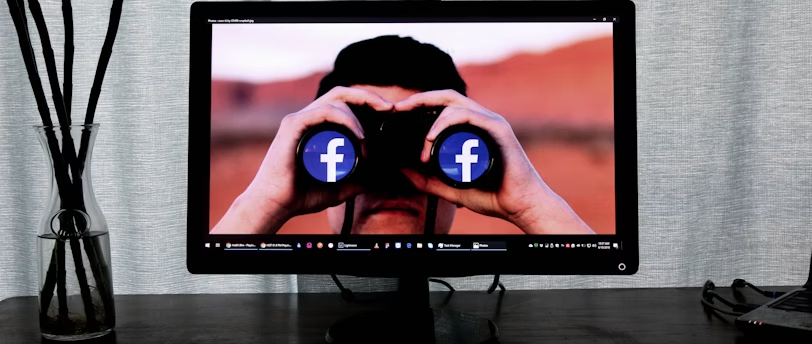
The smart home industry isn’t just selling convenience — it’s collecting your data.
Many mainstream smart devices — from voice assistants to thermostats and video doorbells — are designed to send data to remote servers by default. This includes:
- Continuous voice recordings from smart assistants
- Security camera footage stored on offsite servers
- Light, motion, and door sensor usage patterns that build a detailed behavioral profile
That “cloud convenience” comes with real risks:
- Surveillance creep: Devices that listen and record far more than you realize
- Data misuse: Your behavioral data sold to or shared with advertisers and third parties
- Breach vulnerability: Remote servers are among the most common targets in cyberattacks — and your footage or access credentials could be in the middle of it
With over 20 years in cybersecurity and internet infrastructure, I’ve seen how enterprise-level data breaches happen. The same vulnerabilities exist in consumer smart home platforms — they’re just less visible to the average homeowner. Researchers at NYU found previously undisclosed security and privacy threats across 93 different smart home devices, and NPR reported that Amazon shared Ring camera footage with law enforcement without user consent or a warrant — a stark reminder that when your data lives on someone else’s server, you’re not the one deciding what happens to it.
At Serenity Smart Homes, we flip that model. Our privacy-first installations are rooted in local control and data sovereignty:
- We use Z-Wave and other local protocols to keep device communication inside your home
- Cameras are routed to local NVRs, not third-party cloud platforms
- Everything is unified through Home Assistant, an open-source platform that runs entirely on your local network
Local Control vs. Cloud-Based Smart Home: What’s the Real Difference?
You don’t have to trade functionality for privacy. You just need better tools.
The idea that privacy and smart home automation are mutually exclusive is one of the most persistent myths in this industry — and it’s largely kept alive by companies that profit from your data.
Here’s what privacy-first automation actually looks like for real families and households:
- A caregiver managing both a young child and an aging relative can have motion sensors and door alerts that quietly notify them of wandering or unusual movement — without sending footage to a cloud server or triggering a false-alarm police call.
- A home-based professional running client sessions out of their home can have smart locks, automated lighting scenes, and environmental controls that create a calm, welcoming space — while keeping their client interactions completely disconnected from Big Tech’s data pipelines.
- A rental property owner can automate guest access codes, lighting resets, and noise monitoring across multiple units — without handing control of their properties to a third-party platform they don’t own or fully understand.
In every case, the system is built around your needs — not a subscription model. That means you’re never paying for features you don’t want, and you’re never handing over data you didn’t intend to share.
What a Privacy-First Smart Home System Actually Includes
Real scenarios. Real peace of mind.
Privacy-first automation isn’t a theoretical concept. Here’s how it works in the homes we build:
- Surveillance cameras: Installed with local storage (NVR or NAS) and optional remote access through an encrypted VPN connection. You can check your cameras from anywhere in the world without your footage ever touching a third-party server.
- Voice control: If you’re already in the Apple ecosystem, the HomePod or HomePod mini is our top recommendation among mainstream voice assistants — and it’s not particularly close. Unlike Amazon Alexa or Google Home, Apple HomeKit processes commands locally on-device through Siri, doesn’t store your voice recordings by default, and keeps your automations running even when the internet goes out. It’s the only one of the big three that treats privacy as a design principle rather than a setting you have to dig for. The tradeoff is that it requires Apple devices and HomeKit-certified hardware, which carries a higher price tag. For households that aren’t in the Apple ecosystem, we’ll talk through locally controlled alternatives during your consultation.
- Lighting and automation scenes: Programmed to run entirely locally, so your morning routine, bedtime sequence, or “everyone’s leaving” scene works reliably whether your internet is up or not.
- Door and motion sensors: Set up to send quiet, private alerts to your phone — no third-party monitoring service, no subscription, no external server required.
One client told us how relieved they were knowing their home security footage never left the house — even when they were checking it from hundreds of miles away. Another shared how automating their evening wind-down routine finally made bedtime feel manageable instead of chaotic.
These setups are never one-size-fits-all. Every installation is a collaboration — built around your lifestyle, your safety concerns, and your specific trust boundaries.
Get a Written Plan for Your Smart Home and Home Safety, From Anywhere.
Built for people managing a parent's home from a distance, and for anyone outside South Jersey who wants professional guidance on their smart home and home safety setup. A structured remote assessment of your smart home technology, lighting, whole-home systems, and the routines that depend on them. Within 5 business days you get a prioritized written plan: what to fix first, what to add, what to replace, and where not to spend money. Local control by default, no required subscriptions. Available nationally and internationally.
How Serenity Smart Homes Designs Privacy-First Automation in New Jersey
You don’t need to be a tech expert to demand better. You just need someone in your corner.
At Serenity Smart Homes, we’re not just here to install gadgets. We’re here to help you understand what your devices are doing behind the scenes — and to build something that aligns with your values.
That means:
- Explaining what each device collects, transmits, and stores before it goes in your home
- Designing systems that match your privacy values, not just your wish list
- Building around local control from the start, so you’re not retrofitting privacy later
- Providing ongoing support so your home grows with you instead of against you
You deserve a smart home that empowers you, not one that reports on you.
Smart home automation doesn’t have to come at the cost of your peace of mind. Book a free 30-minute discovery call and I’ll listen to what you actually want your home to do, what your current setup might be sharing without your knowledge, and what a genuinely private alternative could look like for your household. In-person assessments cover South Jersey, Southeastern PA, and Northern Delaware. The Remote Safety Snapshot is available anywhere in the world.