Why I Focus on Local Control Smart Home Technology
When the home safety assessment recommends technology, this is the philosophy that shapes every recommendation. Local control, privacy-first, subscription-free, and designed to outlast any company's roadmap.
Book Your Free 30-Minute Discovery CallLocal Control Is the Starting Point, Not the Bonus Feature.
Most smart home technology is sold to you as convenience. What is happening underneath the convenience is surveillance capitalism: your routines, your comings and goings, your sensor data, your camera footage, all of it flowing to a corporate server somewhere, monetized in ways that are documented in a terms of service that nobody read.
Local control is the alternative. Your data stays in your home. Your automations keep running when the internet goes down. The system that you bought today still works five years from now, after the manufacturer has been acquired or pivoted or sunsetted an app. You are not renting your smart home back from a company that no longer remembers you exist.
This page is the philosophy behind every technology recommendation that comes out of the Home Safety and Technology Assessment. If the assessment says technology is the right answer for your household, this is the kind of technology I specify, and this is why.
What Local Control Smart Home Technology Means in Practice
Four principles. Every technology recommendation in the assessment runs against them.
What you get
- Local control. Automations run on hardware in your home, not on a corporate server. The system works when your internet does not.
- Privacy-first architecture. Your sensor data, your camera footage, your daily patterns stay on the property. Nothing gets harvested.
- Subscription-free operation. You pay for hardware once. There is no monthly fee to access your own home.
- Hardware that outlasts the company. Open standards and locally controlled platforms keep working after a vendor is acquired, pivots, or shuts down.
- Documentation that you own. The system is set up so that any qualified installer can take over support if you ever stop working with me.
What you avoid
- Surveillance capitalism baked into your home
- Monthly fees for features that you have already bought
- Apps that get deprecated and take your automations with them
- Cloud outages that lock you out of your own house
- Behavioral data sold to advertisers without your meaningful consent
What Local Control Smart Home Technology Looks Like in Your Household
Three futures, anchored in the three audiences I work with most.
For the household planning to stay in place
A hallway that lights itself softly at two in the morning, when a parent navigates the path to the bathroom. A leak sensor that closes the supply valve before a burst hose becomes a flooded basement. A door sensor that alerts a sibling, without a camera in the entry, when an aging parent's routine slips. Nothing leaves the property. Nothing requires a subscription. Nothing depends on a company that has not gone out of business yet.
For the neurodivergent household
Lighting that anchors transitions for a sensory-sensitive teenager, dimming gradually at bedtime and brightening gradually at wake-up. A morning routine that runs before the household even has bandwidth to negotiate it. Alerts that arrive only when something actually needs your attention, and stay silent the rest of the time. A system that does the work that working memory should not have to.
For the multigenerational household
Sensory accommodations for one household member that do not collide with another's needs. A nighttime mode that works for the autistic teenager and the aging grandparent simultaneously. A network architecture that segregates children's devices from household automation from work-from-home traffic, without anyone having to think about it. The complexity gets managed by the system, not by the family.
The Smart Home Technology I Specify
When the assessment recommends technology, these are the platforms and protocols I write into the report.
Loxone
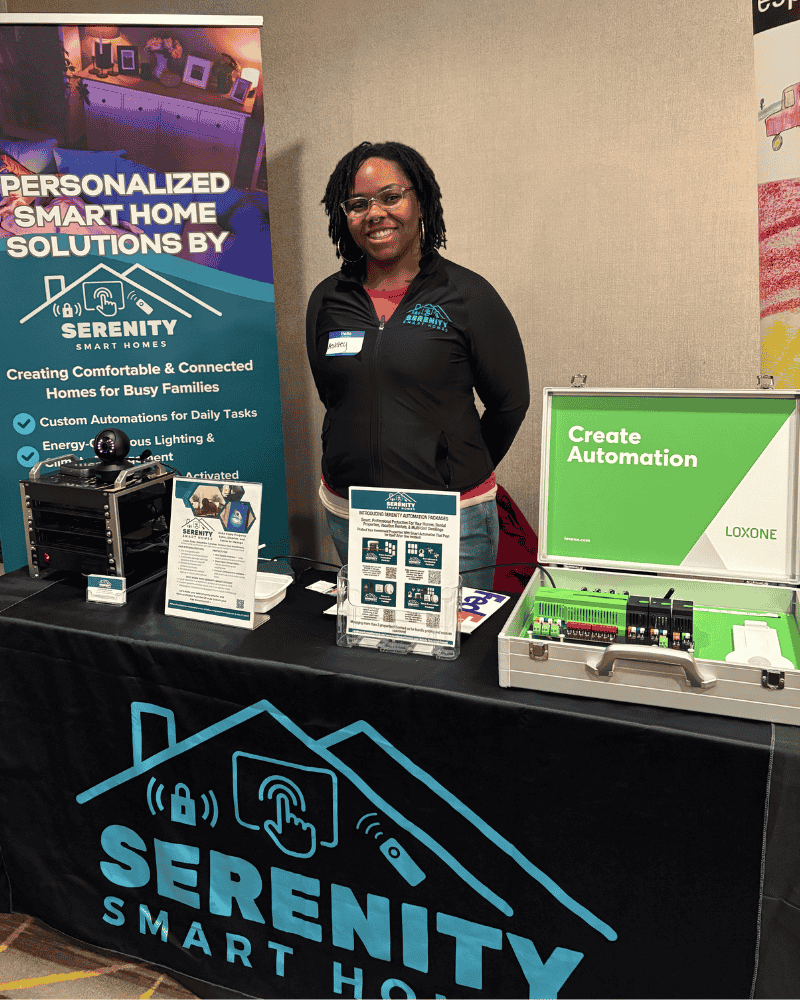
The premium platform that I am certified to specify as a Loxone Silver Partner. Loxone is a commercial-grade, locally controlled whole-home automation platform where the hardware and software are designed by the same team. Lighting, climate, shading, security, and notifications work together on a single system that runs on your local network and stays out of the cloud. Loxone is what I specify when the assessment calls for a polished, integrated, set-and-forget system.
Z-Wave, Zigbee, Thread, Matter
Open wireless protocols designed to be interoperable, long-lived, and vendor-independent. These are the protocols I specify when the assessment calls for sensors, smart locks, leak detectors, and the long tail of devices that a household typically wants to add over time. Open standards mean that a device from one manufacturer can be replaced by a device from another, without ripping out a system.
Home Assistant
The open-source automation hub that I specify when a household wants to unify devices across multiple protocols, or extend a locally controlled setup beyond what a single vendor platform covers. Home Assistant runs on hardware in your home, keeps your data on the property, and connects to virtually every smart-home protocol. Maintained by an open-source community that outlasts any individual company.
Lutron
The lighting and shading standard that I specify when the assessment calls for high-end fixture control or motorized shading. Lutron systems are reliable, locally controlled, and widely supported by integrators who can take over service if you ever stop working with me.
UniFi and Omada networking
The network infrastructure that I specify so that the smart home actually works. Most smart home failures are network failures. A locally managed UniFi or Omada deployment gives the home a real network, with separate segments for IoT devices, work-from-home traffic, guests, and family. No cloud dependency, no managed-service subscription.
Fully Kiosk
The local-control interface that I specify when a household wants a wall-mounted tablet for daily routines and family scheduling. Fully Kiosk runs on Android tablets that are mounted in the home, controlled locally, and configured to display whatever the household actually needs at a glance.
Certified Loxone Silver Partner in South Jersey
Loxone's US headquarters is just outside Philadelphia, PA. Serenity Smart Homes is in Cherry Hill, NJ. The proximity is not just convenient, it is operationally useful.
I am certified to design and specify Loxone systems for households that the assessment routes toward a polished whole-home platform. Silver Partner status means that I have access to Loxone's coaching and partner network for complex configurations, and that the work I write into a report has the manufacturer behind it.
When the assessment recommends Loxone, the report names exactly which Loxone hardware to use, where it goes, and what it does. The implementation gets handed off to a vetted installer with my coordination, or to whoever you already trust if you have an existing relationship.

Technology Is Not the Starting Point. The Assessment Is.
Nothing on this page is something that you buy off this page. The recommendations come out of the Home Safety and Technology Assessment, scoped to your household, sequenced by impact, with rough cost ranges named.
If the assessment says your household needs no technology at all, the report says that, and you save the money. If the assessment says local-control automation is the right answer, then the technology on this page is what gets specified. Either way, the decisions stay with you.
Book Your Free 30-Minute Discovery CallCommon Questions About Local Control Smart Home Technology
Local-control systems keep your data on the property, keep working when the internet does not, and do not require a monthly fee to use what you already own. Alexa, Ring, and Nest are cloud-dependent platforms with surveillance capitalism baked in. They are sold as convenient, and they are. They are also sold as cheap, and they are not, once you account for the subscription fees, the data harvesting, and the risk that a company changes its terms or sunsets a product.
The report from your assessment names exactly what you have, what is worth integrating with a local-control architecture, what is worth replacing, and what is genuinely fine to keep using as-is. Not every cloud device is a problem. The report distinguishes between low-stakes convenience devices and devices that are collecting safety-critical data or sitting in a sensitive part of the home.
Most clients do. The report sequences recommendations by impact, with quick wins for this week, low-cost items for the next month, and longer-term capital improvements for when budget and timing align. Starting small is a feature, not a workaround. A locally controlled system can be added to over years, without ripping out what is already working.
No. I am a consultant, not an integrator and not a contractor. The report specifies what to install and which type of professional should do the work. You can hand the report to any installer you already trust, or I coordinate warm referrals to vetted local professionals.
Local-control systems are built so that this does not break your home. Open protocols like Z-Wave and Zigbee mean a device from a defunct manufacturer can be replaced by a device from another manufacturer without ripping out the system. Loxone runs locally on your hardware, so a corporate event does not stop your automations from working. This is part of why I specify what I specify.
The assessment is the gateway. The 230-point walkthrough surfaces what your household needs, ranked by priority. Where technology is part of the answer, the recommendations default to the local-control philosophy on this page. Where technology is not the answer, the report says so. The free 30-minute discovery call confirms whether the assessment is the right next step.
Motion-activated pathway lighting is the highest-impact starting point. Most falls happen at night along the bedroom-to-bathroom route, and automatic lighting eliminates the decision and the dark in the same step. Beyond lighting, Z-Wave contact sensors on exterior doors catch exit events before they become elopement or wandering incidents. Floor sensor mats at the bedside flag nighttime movement for households where a caregiver alert matters. Leak detection at appliances and plumbing access points addresses water-damage falls from wet floors. All of these are locally controlled, subscription-free, and specified only when the Home Safety and Technology Assessment identifies them as the right fit for a particular household.