Remote Home Safety Assessment for Aging-in-Place and Neurodivergent Households
A guided video walkthrough of your home, plus a written findings report. Built for people helping a parent from a distance, neurodivergent households, and anyone who wants professional eyes on the home without waiting for a local visit to be possible.
Book Your Free 30-Minute Discovery Call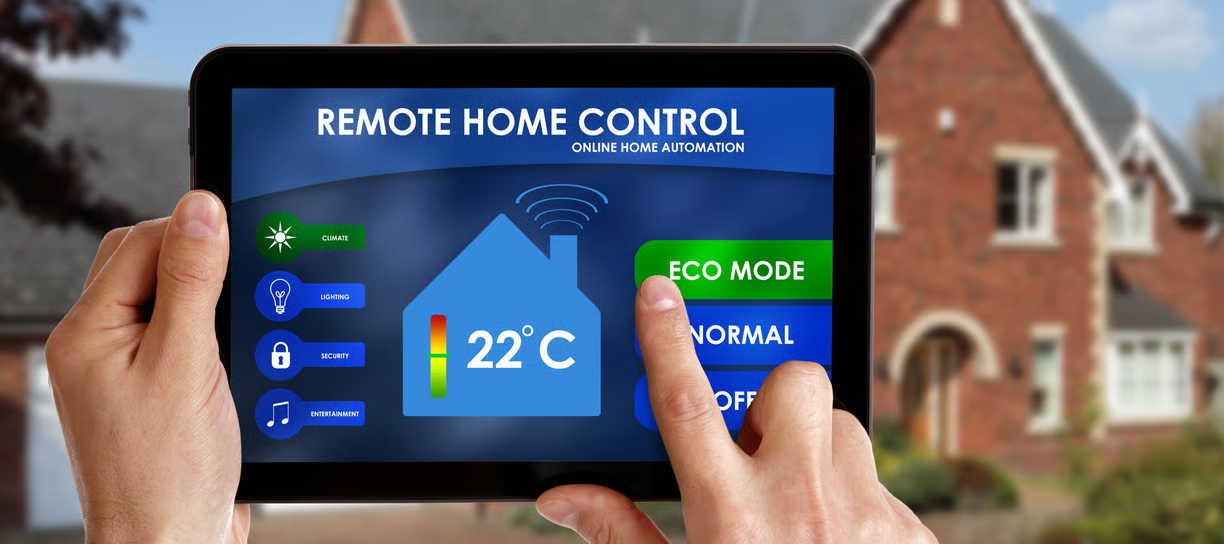
A Professional Remote Home Safety Assessment, No Visit Required
The Remote Safety Snapshot is a guided 60 to 75 minute video walkthrough of your home, followed by a written findings report. It is built for the households that need an assessment now, not in three weeks, and not contingent on geography.
You are probably here for one of three reasons. Your parent lives two states away, and you are trying to help them think through their home without flying in. Or your schedule does not have a two-hour window for a home visit, but it does have a Saturday morning. Or you are not yet sure what level of support makes sense, and you want professional eyes on the situation before you commit to anything bigger.
The Remote Safety Snapshot is built for all three. It is a complete, self-contained service, not a stripped-down version of the in-person assessment. The discipline of doing it well is knowing what can be assessed reliably over video, being honest about what cannot, and telling you clearly when something on the home needs an in-person look.

What the Remote Home Safety Assessment Covers
Concrete scope, honestly named. The areas where guided video genuinely works, and the areas where it does not.
What is included
- Household intake, including who lives there, relevant conditions or concerns if disclosed, recent incidents, and what prompted outreach
- Technology ecosystem review, including existing devices, hubs, voice assistants, PERS devices, app dependencies, reliability, and privacy posture
- Exterior and entry, including visible hazards, lighting, pathway, threshold, and lock assessment from photos and directed video
- Kitchen, including stove and appliance safety, cognitive support opportunities, and alert systems
- Living areas, including trip hazards, seating, environmental controls, and sensory factors
- Whole-home systems, including smoke and CO coverage, water temperature, leak detection, and electrical basics
- Lighting, including coverage, automation opportunities, and nighttime navigation
- Sensory environment, executive function, and routine anchoring, when the household profile calls for it
- Caregiver and family integration, including remote monitoring, alert routing, and privacy considerations
- Client goals and priorities, including what matters most and what the household has already tried
What is not included, and why
Bathrooms, stairways, and flooring transitions require physical presence to assess safely and accurately. They are the highest fall-risk areas in any home, and they are the ones where a misread from video causes the most harm.
If those areas are a concern, and they often are, the Remote Safety Snapshot will tell you that. The written report will recommend a targeted in-person follow-up, scoped specifically to the rooms that need it.
This is not a workaround for the in-person assessment. It is the honest version of what a remote assessment can do well, and it is the only version that I am willing to offer.
Learn about the full in-person Home Safety and Technology Assessment.
How the Virtual Home Safety Walkthrough Works
Four steps, on your schedule, from anywhere.
1. Pre-session intake
You receive a short questionnaire 24 to 48 hours before your session. It covers household composition, recent incidents or near-misses, current technology, caregiver structure, and your top three concerns. You also submit a small photo set, typically the front entry, kitchen, main living area, and electrical panel location, so that I can review them before the session.
2. Guided video session
The video session runs 60 to 75 minutes. You walk through your home while I direct the walkthrough, telling you what to show me, how to angle the camera, and what questions to answer along the way. You do not need any technical setup beyond a smartphone with a working camera.
3. Findings report
Within five business days, you receive a written summary of findings, a prioritized action list, a technology assessment, and a clear statement of whether a full in-person assessment is warranted and for which areas. The report uses plain language and a shareable summary page that is built for siblings, partners, and care coordinators.
4. Report review call
A 20 to 30 minute call to walk through the report together, answer questions, and confirm the sequence of next steps. The review call is included. Anyone who needs to be on the line, a sibling, a partner, a care coordinator, is welcome.
What's in Your Remote Home Safety Assessment Report
Named deliverables, briefly described. Same report structure as the in-person assessment, scoped to what was actually assessed.
- Findings summary, including what was observed, what was flagged, and the reasoning behind each priority
- Prioritized action list, with immediate no-cost steps, low-cost recommendations, and items that require contractor or technology installation
- Technology assessment, including your current ecosystem reviewed for gaps, privacy exposure, reliability, and upgrade opportunities
- Plain-language summary page, built for sharing with a sibling, partner, or care coordinator who was not on the call
- Honest scope notation, including a clear statement of what could not be assessed remotely and what follow-up would address it
- In-person recommendation, when warranted, with the exact scope a targeted on-site visit would need to cover, so that you know what you would be booking
- Reassessment trigger list, so that you know what kinds of changes warrant another walkthrough later

Who Books the Remote Safety Snapshot
Three situations that show up consistently in this work.
The family member coordinating from a distance
Your parent is aging in place in a home that you have not seen in a year. You want a professional assessment of what is actually going on, including the safety risks, the technology gaps, and the fall hazards, without requiring a flight or a week-long visit to make it happen. After the session, you have a written document that you can send to your parent, to a local contractor, or to the sibling who lives closer.
The neurodivergent household
You have been thinking about your home differently since a diagnosis, a disclosure, or a season of unraveling routines. You want someone who understands sensory environments, executive function, and the way that a household full of neurodivergent people actually lives, to look at your space and tell you what is worth addressing. The remote format means that the assessment happens on your terms, in your home, at your pace.
The household that wants a starting point
You are not yet sure what level of support makes sense. The Remote Safety Snapshot is a complete service in its own right, and it is also a natural first step for households who want to understand what a full assessment would surface before booking one. Either way, you leave with a report.
The household outside South Jersey
In-person tracks cover South Jersey, Southeastern Pennsylvania, and Northern Delaware. The Remote Safety Snapshot is available nationally and internationally. Geography is not a barrier to getting professional eyes on your home.
Remote vs. In-Person Home Safety Assessment Comparison
An honest comparison. The remote service is not a discounted version of the in-person service, and it is not a fallback. It is a different shape of the same work.
| Remote Safety Snapshot | Full In-Person Assessment | |
|---|---|---|
| Intake and goals | ✓ Full | ✓ Full |
| Technology ecosystem | ✓ Full | ✓ Full |
| Kitchen and living areas | ✓ Full | ✓ Full |
| Sensory and executive function | ✓ Full | ✓ Full |
| Caregiver integration | ✓ Full | ✓ Full |
| Exterior and entry | From photos and video | On-site |
| Bathroom assessment | — | ✓ Full |
| Stairways and flooring transitions | — | ✓ Full |
| Physical measurements | — | ✓ Included |
| Written report | Findings summary, priorities, scope notation | Full assessment report |
| Session length | 60 to 75 minutes | 90 to 150 minutes on site |
| Investment | $295 | $375 / $475 / $575 / $625 by track |
Why I Run Virtual Home Safety Assessments the Way I Do
Remote assessment is easier to do poorly than in-person assessment. The discipline is in knowing what can be observed reliably, being honest about what cannot, and not filling the gaps with guesses. The Remote Safety Snapshot is built around that discipline. It covers the areas where guided video consultation is genuinely effective, it excludes the areas where it is not, and it tells you clearly when what you need is someone standing in the room.
I am Ashley Williams, the principal of Serenity Smart Homes. I am CLIPP-certified (Living In Place Professional #C00967), a Loxone Silver Partner, NJ HIC licensed, NJ SBE and NJ MWBE certified, with 20+ years of enterprise technology experience and lived AuDHD experience that shows up in how I read sensory environment, executive function, and routine. The Remote Safety Snapshot uses the same 230-point instrument that drives the in-person assessment, aligned to CLIPP, CAPS, and SHSS frameworks, scoped to what guided video can carry honestly.
Every assessment is conducted by me personally. There is no team member that I send instead. The recommendations default to local control, privacy-first architecture, no cloud dependency for safety-critical functions, and no subscriptions that the client cannot walk away from.
CLIPP
Certificate for Living in Place Professional
Living in Place Institute
CAPS
Certified Aging in Place Specialist
National Association of Home Builders
SHSS
Senior Home Safety Specialist
Age Safe America
Remote Home Safety Assessment Pricing and Service Area
The Remote Safety Snapshot is $295, flat-rate, with no travel surcharge. The discovery call confirms fit and walks through what is included.
The fee covers the pre-session intake, the 60 to 75 minute guided video session, the written findings report delivered within five business days, and the report review call. Reassessments are available at 75% of the current posted rate. Every report includes a trigger list that names when to come back.
Available nationally and internationally. There is no geographic limit on this service.
Book Your Free 30-Minute Discovery CallWhat Remote Home Safety Assessment Clients Say
"Ashley shows up to each conversation with a startling amount of knowledge on the subject, insights into how things can connect that I would never see, and the patience of a saint. I can't recommend her highly enough."
"The leak sensor saved us from major damage when Mom's washing machine hose burst. The water shut off automatically and we got an alert immediately."
You don't have to see every corner of a home to know what matters most.
But you do have to look. Look with me. 30 minutes on the phone or on video to find out whether the Remote Safety Snapshot is the right next step for your household. If it is, I will tell you how it works and what it costs. If it is not, I will tell you that too, and I will point you toward whoever can actually help.
Book Your Free 30-Minute Discovery CallCommon Questions About the Remote Safety Snapshot
No. A smartphone with a working camera is everything that you need. The walkthrough runs over a standard video call, and I direct the camera angles and the pace from my end so that you can focus on your home rather than on the technology. If a second person in the household can hold the phone while the primary client walks, that helps, but it is not required. I have run sessions one-handed many times.
For many households, yes. The Remote Snapshot covers intake, technology, kitchen, living areas, lighting, whole-home systems, caregiver integration, sensory environment, and cognitive and executive function support at the same depth as the in-person assessment. What it cannot cover honestly is bathrooms, stairways, and flooring transitions. Those are the highest fall-risk areas in any home, and they require physical presence to assess accurately. If the session surfaces concerns in those areas, the report will say so, and I will recommend a targeted in-person follow-up scoped to just those rooms.
That situation is one of the most common reasons clients book this service. The parent walks me through the home on video, the family member joins the call from wherever they are, and the written findings report goes to both of you in plain language that you can share with siblings, partners, or care coordinators. The report becomes the document that the family was missing. The conversation about the house stops being a guess.
Yes, and the format is often easier than an in-person walkthrough. The client stays in their own home, on their own schedule, and at their own pace. The intake form gives me what I need to know in advance, so that the session itself can run shorter and slower if that helps. If the household includes an autistic or ADHD adult or a neurodivergent child, the report addresses sensory environment, executive function support, routine anchoring, and elopement risk where it applies, the same way the in-person Neurodivergent Household assessment does.
Within five business days of the video session. The report includes a findings summary, a prioritized action list across no-cost, low-cost, and contractor-required items, a technology review, and an honest scope notation that names what could not be assessed remotely. If a follow-up in-person visit is warranted, the report says exactly what it would need to cover.
Yes. The video call is not recorded, no footage is retained, and no part of the session is shared with anyone outside the engagement. The intake form and the written report are the only documentation that exists from the work. Privacy in technology recommendations follows the same principle. Every recommendation defaults to local control, no cloud dependency for safety-critical functions, and no data harvesting.
The purpose of a home safety assessment is to identify specific risks and quality-of-life gaps in a home before they become emergencies, and to produce a prioritized, written plan for addressing them. It is not a pass/fail inspection and it is not a product sales visit. You leave with a document that names what to do, in what order, with rough cost ranges, and referrals to the right professionals for each piece. That clarity is the deliverable, whether the assessment is conducted in person or remotely.
A remote home safety assessment should be conducted by someone credentialed in aging-in-place and universal design frameworks, not someone with only a general contractor license or a technology background. The relevant credentials are CLIPP (Certificate for Living in Place Professional), CAPS (Certified Aging-in-Place Specialist), and SHSS (Senior Home Safety Specialist). I hold all three, along with 20-plus years in enterprise technology infrastructure. Every Remote Safety Snapshot is conducted personally by me over guided video, using the same instrument as the in-person work. There is no team, no subcontracting, and no handoff to a junior associate.
The hazards that show up most consistently are inadequate lighting at exterior entrances and along interior circulation paths, especially the route between bedroom and bathroom at night; clutter and trip risks in high-traffic areas; the absence of a zero-step entrance into the home, which is one of the most common barriers to safe, independent living and one of the most overlooked; flooring transitions and thresholds that create fall risk; bathroom fixtures and grab bar placement that do not match how the person actually moves; unsecured or poorly managed medications; and the absence of leak detection in homes with aging plumbing or appliances. The Remote Safety Snapshot surfaces most of these. The honest exception is bathrooms, stairways, and flooring transitions, which require physical presence to assess accurately. When the remote session raises concerns in those areas, the report flags them and recommends a targeted in-person follow-up.